dots.tts.edit
Precisely Controlled Speech Editing
with a Continuous Autoregressive Model
1 Xiaohongshu Inc.
2 X-LANCE Lab, School of Computer Science, Shanghai Jiao Tong University
3 School of Intelligence Science and Technology, Nanjing University
wanghankun@xiaohongshu.com; {wanghankun,kai.yu}@sjtu.edu.cn
dots.tts.edit uses a transcript-grounded structural edit instruction with XML-style tags to specify what to change, where to change it, and the requested parameters. A continuous autoregressive model performs text, emotion, prosody, and pause edits, including their composition, while preserving the surrounding speech and speaker identity. Built on dots.tts.
First Glance
Two speakers. Two languages. Four edit types in one instruction.
Apply two text replacements, slow down an English phrase, insert a pause, and add melancholic delivery while preserving the surrounding speech and each speaker’s identity.
Overview

doteBench Evaluation
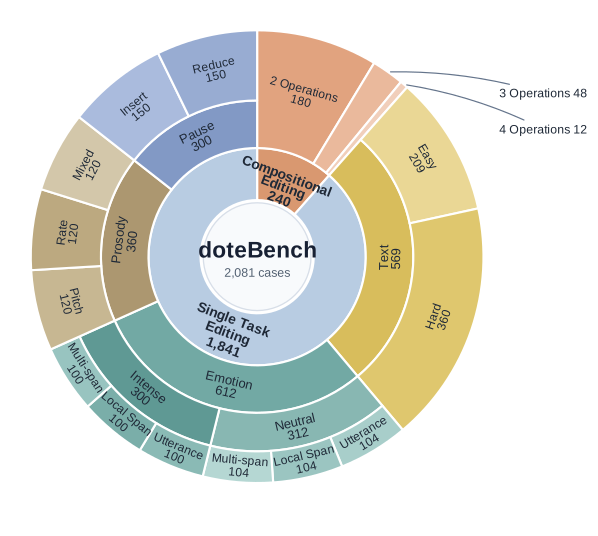
doteBench V1.0 evaluates precise speech editing on 2,081 English and Chinese cases: Text (569), Emotion (612), Prosody (360), Pause (300), and Compositional (240). It measures three complementary dimensions: instruction following within the requested regions, local preservation of content, timing, pitch, and speaker identity, and audio quality of the result.
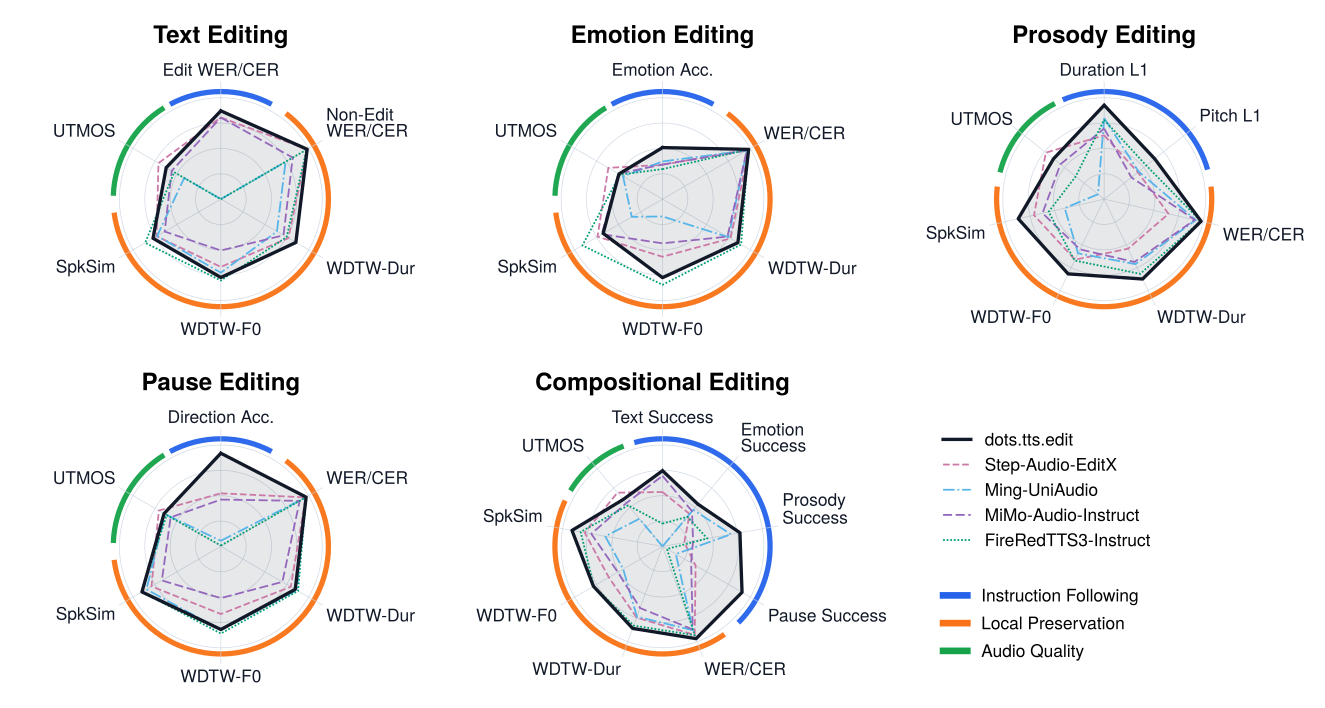
Instruction following: edited-region WER/CER, emotion accuracy, pitch and duration errors, pause direction accuracy, and per-family compositional success.
Local preservation: content WER/CER, word-level duration and F0 preservation (WDTW-Dur and WDTW-F0), and WavLM ECAPA speaker similarity. Acoustic metrics use the eligible regions defined by each XML operation; F0 uses Praat.
Audio quality: UTMOS22 on the generated utterance.
One-take editing
Each complete instruction is compiled into one model call.
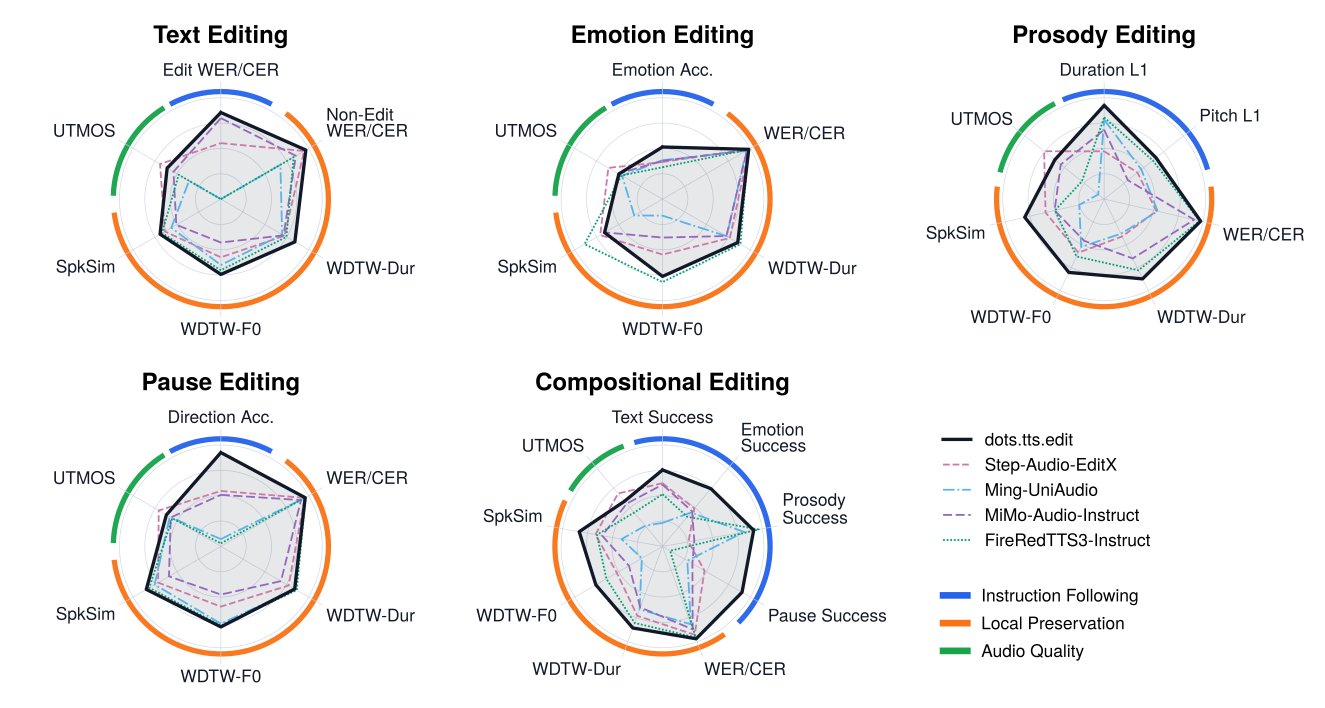
Sequential editing
Each XML operation is executed in a separate model call; its output becomes the input for the next edit. Evaluation scores the final audio.
Reference results · all 2,081 cases
Operation success averages measurable requested operations. All-operations success requires every measurable operation in a case to succeed.
AuK uses Qwen3-ForcedAligner for local editing; the radar charts compare the five single-model systems.
Sources: doteBench release · Paper · Evaluation protocol.