

dots.tts.edit V1.1
Precisely Controlled Speech Editing
with a Continuous Autoregressive Model
dots.tts.edit uses a transcript-grounded structural edit instruction with XML-style tags to specify what to change, where to change it, and the requested parameters. A continuous autoregressive model performs text, emotion, prosody, and pause edits, including their composition, while preserving the surrounding speech and speaker identity. Built on dots.tts.
We recommend using our  Playground to try the model interactively. The Playground is also open source and can be self-hosted.
First Glance
The edited audio is generated in a single inference pass.
Overview

doteBench Evaluation
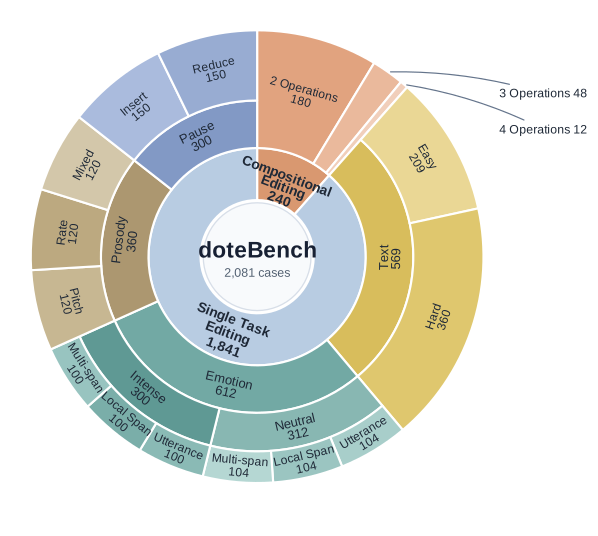
doteBench V1.0 evaluates text, emotion, prosody, pause, and compositional edits in English and Chinese.
Editing tasks
Evaluation metrics
Instruction following: edited-region WER/CER, emotion accuracy, pitch and duration errors, pause direction accuracy, and per-family compositional success.
Local preservation: content WER/CER, word-level duration and F0 preservation (WDTW-Dur and WDTW-F0), and WavLM ECAPA speaker similarity. Acoustic metrics use the eligible regions defined by each XML operation; F0 uses Praat.
Audio quality: UTMOS22 on the generated utterance.
One-take editing
The complete instruction is applied in a single model call.

Sequential editing
Edits are applied one at a time, each building on the previous output.

Reference results
Precise editing combines instruction following with preservation of the source speech.
1 AuK uses the official Prompt Enhancer.
Except for the Expert Data Pipeline, all edited examples are generated by their respective models in a single inference pass (one-take).